


If you have ever stared at a whole brisket and wondered whether you are about to waste twelve hours and forty quid, you are not alone. Smoking brisket over live fire is one of the most rewarding things you can cook, but it demands respect, patience and a method you can trust.
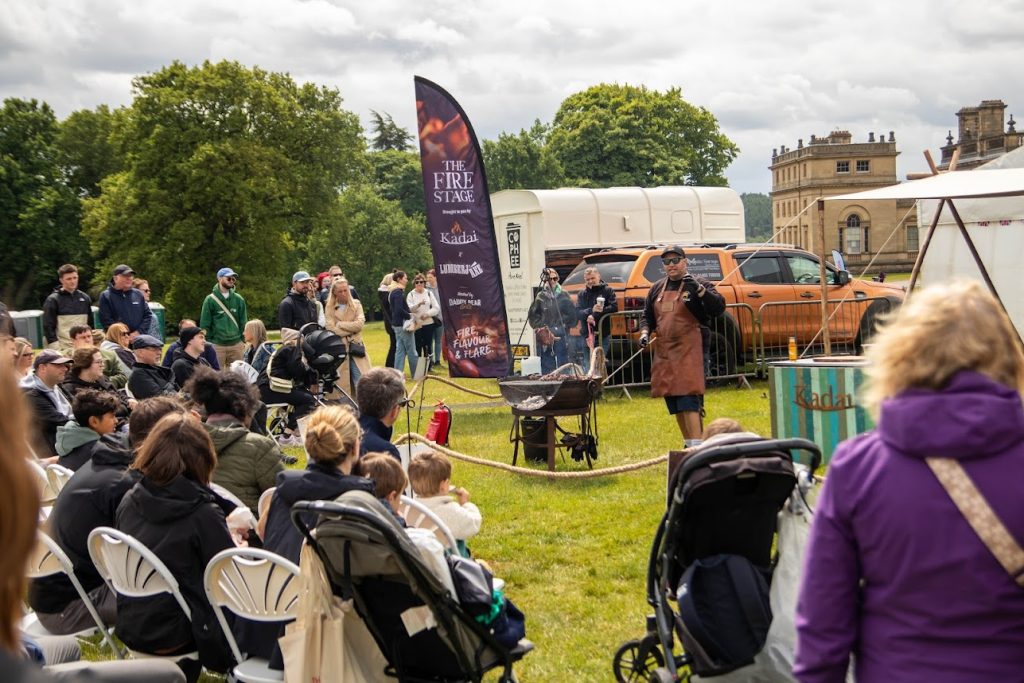
This live fire smoked brisket recipe is the same method we teach at our woodland cooking experiences in Kent. It has been tested over dozens of cooks, refined through competition and shaped by the realities of cooking outdoors in British weather.
By the end of this guide, you will know how to choose, trim, season, smoke and slice a brisket using nothing but real fire, real wood and real patience. No pellet grill controllers. No shortcuts. Just flame and flavour.
Quick answer: Live fire smoked brisket is a whole packer brisket cooked low and slow over real wood or charcoal at around 110°C (225°F) for 10 to 16 hours. The keys to success are steady fire management, wrapping at the stall and resting the meat for at least one hour before slicing against the grain.
What You Need to Smoke Brisket Over Live Fire
Before you touch the meat, get your setup right. Live fire cooking does not require expensive equipment, but it does require the right essentials.
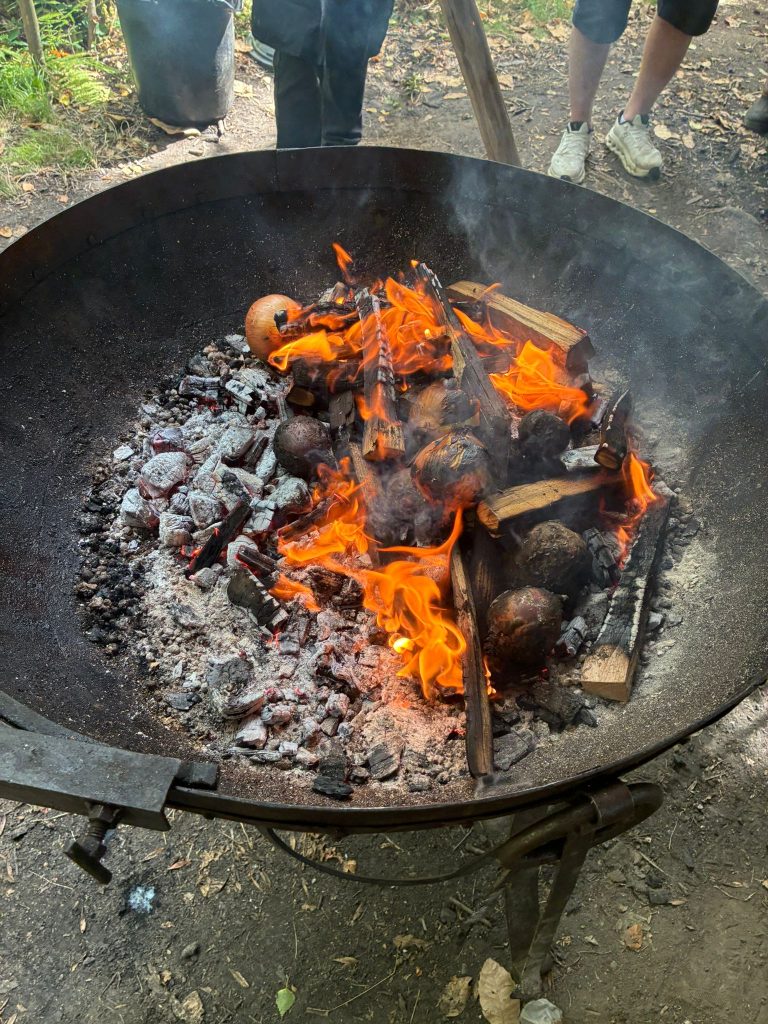
Your fire source can be an offset smoker, a kettle barbecue, a kamado or even a kadai firebowl. What matters is that you can create indirect heat and control airflow. If it holds a fire and has a lid or cover, it will work.
Essential tools: a reliable instant-read meat thermometer (this is non-negotiable), pink butcher paper, a spray bottle filled with apple cider vinegar or beef stock, a sharp carving knife and heat-resistant gloves. A cool box with no ice is also useful for the resting stage.
Best Wood for Smoking Brisket in the UK
The wood you burn is the seasoning you cannot buy in a jar. Here are the best options available to UK cooks:
- Oak: The standard for brisket. Medium-intensity smoke with a clean, steady burn. If you only use one wood, make it oak.
- Cherry: Adds a subtle sweetness and gives the bark a deeper mahogany colour.
- Apple: Mild and fruity. Works well blended with oak for a lighter smoke profile.
- Beech: Clean-burning and widely available. A solid alternative if oak is hard to source.
- Avoid softwoods (pine, spruce, larch): These contain resin that produces bitter, acrid smoke. Never use them for cooking.
Always use seasoned (dried) wood. Green or freshly cut wood produces thick white smoke that tastes harsh and will ruin the bark.
How to Choose and Prepare Your Brisket
This is where UK cooks need to pay close attention. Walk into most British butchers and ask for brisket, and you will get a lean, rolled joint. That is not what you want.
Ask your butcher for an untrimmed, full packer-cut brisket that includes both the flat and the point. Explain that you are smoking it whole, American-style. A good butcher will know what you mean, and many can order one in with a few days’ notice. Aim for 4 to 6 kg.
UK brisket comes from grass-fed cattle, which means the fat is leaner and renders at a lower temperature than grain-fed American beef. This is not a disadvantage, but it does change how you handle it. Leave a slightly thicker fat cap (around 6 to 8mm) than American recipes suggest to protect the meat during the long cook.
Trimming Your Brisket
Place the brisket on a large chopping board, fat cap facing up. Using a sharp knife, trim the fat cap to an even 6 to 8mm across the whole surface. Remove any hard, waxy fat that will not render down.
Flip it over. Remove the silver skin and any loose flaps of meat or fat from the underside. Round off any thin edges on the flat, as these will dry out and burn during the cook. The goal is an aerodynamic shape that cooks evenly.
Spend 20 minutes on this step. Proper trimming is the difference between a good brisket and a great one.
Seasoning Your Brisket
Keep it simple. When you are cooking over live fire, the smoke and flame do the heavy lifting.
The classic rub is a 50/50 mix of coarse salt and coarse black pepper. That is it. Apply it generously on all sides, including the edges. You want a visible, even coating.
Some cooks add a thin layer of yellow mustard before the rub. The mustard burns off during the cook and leaves no flavour, but it helps the salt and pepper stick to the surface.
Optional additions include garlic powder and smoked paprika, but these are supporting players, not the star. Season at least one hour before cooking. Overnight in the fridge, uncovered, gives the salt time to penetrate the meat and helps form a better bark.
Building and Managing Your Fire
This is the section that separates live fire cooking from everything else. If you can manage a fire, you can smoke a brisket. If you cannot, no recipe will save you.
Start with a bed of quality lump charcoal. Light it using a chimney starter or natural firelighters. Never use lighter fluid. Once the charcoal is ashed over and glowing, add two or three fist-sized chunks of your chosen smoking wood.
Your target temperature is 110°C (225°F), measured at grate level where the brisket will sit. Use your vents to control airflow: more air means more heat, less air means less. Small adjustments are better than big ones.
Reading the Smoke
Thin, blue-tinted smoke is what you want. This is clean combustion and it deposits a sweet, complex flavour on the meat.
Thick, billowing white smoke means incomplete combustion. It contains creosote, which tastes bitter and will leave an unpleasant film on the brisket. If you see white smoke, open your vents slightly to increase airflow.
In our live fire cooking classes, fire management is the skill people find hardest and the most rewarding to master. The fire is alive. It responds to wind, humidity and the wood you feed it. Learning to read those signals is what makes live fire cooking so satisfying.
Can You Smoke a Brisket on an Open Fire?
Yes. A brisket can be smoked over any fire source that provides consistent indirect heat at around 110°C (225°F). Open fire pits, kadai firebowls and simple kettle barbecues all work well, provided you can control the airflow and maintain a steady temperature for 10 or more hours. The key is patience and attention, not expensive kit.
How to Smoke a Brisket: Step by Step
Once your fire is stable at 110°C (225°F) and producing clean smoke, you are ready to cook.
- Place the brisket on the grate, fat side down, positioned away from the direct heat source. If you are using an offset smoker, the thicker point end should face the firebox. Close the lid.
- Smoke unwrapped for 4 to 6 hours. During this phase, the bark forms and the meat absorbs most of its smoke flavour. Resist the urge to open the lid constantly. Every time you lift it, you lose heat and smoke.
- Start spritzing after the bark sets (usually around hour 3). Use apple cider vinegar or beef stock in a spray bottle. A light mist every 60 to 90 minutes keeps the surface moist and helps build deeper bark colour.
- Monitor for the stall. When the internal temperature reaches around 65 to 75°C (150 to 170°F), it will plateau. This can last for hours. Do not panic. This is normal.
- Wrap the brisket in pink butcher paper. Remove it from the smoker, lay it on two overlapping sheets of butcher paper, and wrap tightly. Return it to the smoker with the seam side down.
- Continue smoking until the internal temperature reaches 96 to 98°C (203 to 207°F). More importantly, probe the thickest part of the flat with a thermometer or skewer. It should slide in with almost zero resistance, like pushing through room-temperature butter.
- Rest the brisket for at least 1 hour, ideally 2 to 4 hours. Keep it wrapped in the butcher paper and place it in a cool box (no ice). This lets the juices redistribute and the collagen continue to break down. Skip this step and your cutting board will be swimming in liquid that should be in the meat.
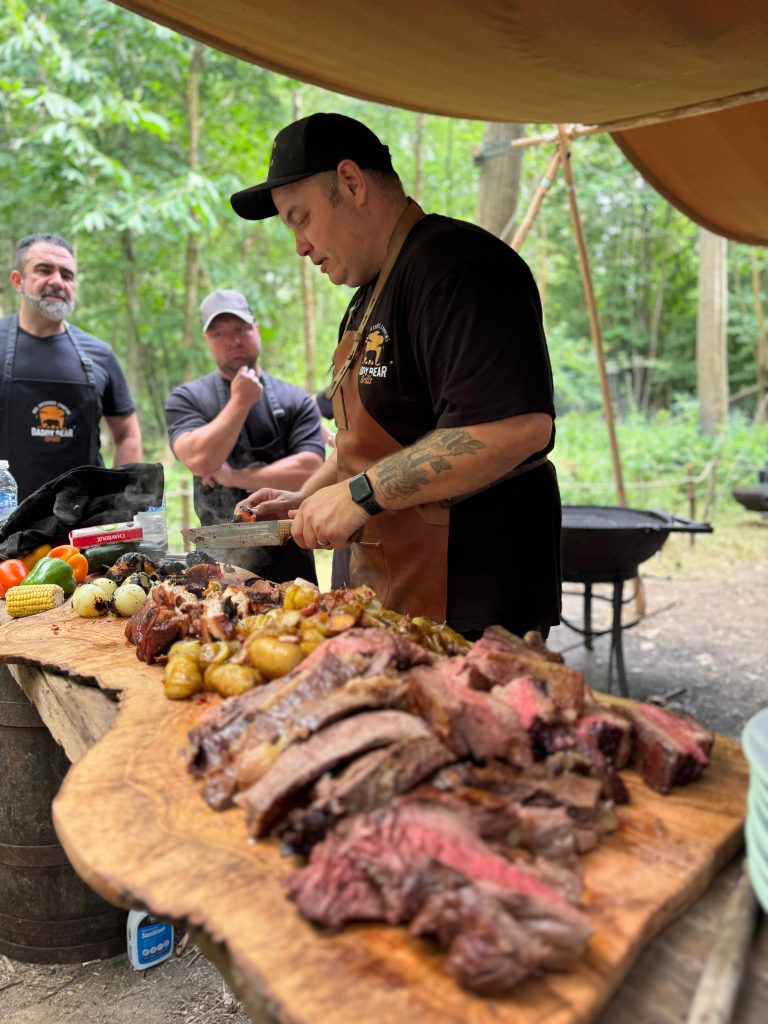
- Slice against the grain. Separate the point from the flat. Slice the flat into pencil-thin slices, cutting perpendicular to the muscle fibres. Turn the point 90 degrees and slice that separately.
How Long Does It Take to Smoke a Brisket?
At 110°C (225°F), expect roughly 1 to 1.5 hours per pound of brisket. A 5kg (11lb) full packer typically takes 10 to 16 hours, depending on the thickness of the meat, weather conditions and how well you maintain your fire.
Always cook to internal temperature, not to a clock. Two briskets of the same weight can finish hours apart. A reliable meat thermometer is the single most important tool in this entire process.
Should I Wrap Brisket in Foil or Butcher Paper?
Butcher paper is the preferred choice for most experienced pitmasters, and it is what we recommend at Daddy Bear Grills.
| Method | Bark | Moisture | Best For |
| Butcher paper | Excellent, stays firm | Very good | Live fire, offset |
| Aluminium foil | Softens significantly | Excellent retention | Speed, beginners |
| No wrap | Maximum bark | Risk of dry flat | Experienced cooks |
Butcher paper is breathable. It lets enough moisture escape to keep the bark intact while trapping enough steam to push through the stall. Foil creates a tighter seal that retains more liquid, but it can turn your bark soft and give the meat a steamed, pot-roast quality.
If this is your first brisket, foil is more forgiving. Once you are comfortable with the process, switch to butcher paper and you will notice the difference immediately.
5 Common Brisket Mistakes and How to Avoid Them
Every brisket teaches you something. Here are the mistakes we see most often, both in our classes and in our own early cooks.
- Cooking to time instead of temperature. The “one hour per pound” rule is a rough guide, not gospel. Two briskets of the same weight can finish hours apart. Use a thermometer. Probe for tenderness. The brisket is done when it feels like butter, not when the clock says so.
- Not resting long enough. Slicing a brisket straight off the smoker sends all those rendered juices flooding onto the board. Rest for a minimum of one hour, wrapped, in an insulated cool box. Two to four hours is better.
- Dirty smoke from bad fire management. If your wood is unseasoned, your fire is smothered or your vents are closed too far, you will produce thick white smoke full of creosote. The result is a bitter, acrid flavour that no rub can hide. Burn clean. Burn hot enough for thin blue smoke.
- Over-trimming the fat cap. This is especially common with UK grass-fed brisket, which is already leaner than American grain-fed cuts. Leave 6 to 8mm of fat to insulate the meat. Trim too aggressively and you will end up with a dry, chewy flat.
- Slicing with the grain. The muscle fibres in a brisket are long and tough. Slicing parallel to them gives you chewy, stringy meat. Always cut against (perpendicular to) the grain. The flat and point run in different directions, so separate them first.
What Is the Stall When Smoking Brisket?
The stall is a period during the cook when the brisket’s internal temperature stops rising, typically between 65 and 75°C (150 to 170°F). It happens because moisture evaporating from the surface of the meat cools it at the same rate the smoker is heating it. Think of it like sweating on a hot day.
The stall can last anywhere from one to four hours. It is the point where many first-time cooks lose their nerve and crank the heat. Do not do this. The stall is when the bark is forming and the connective tissue is beginning to break down.
Wrapping in butcher paper (sometimes called the Texas crutch) reduces evaporation and pushes through the stall more quickly. According to meat science research from Texas A&M University, collagen in brisket begins converting to gelatin at around 71°C (160°F) and completes the process near 96°C (205°F). That breakdown is what transforms a tough cut into something tender.
A Note on Food Safety
The Food Standards Agency recommends that beef reach an internal temperature of at least 70°C for two minutes to be considered safe. A properly smoked brisket will far exceed this threshold, reaching 96 to 98°C at its core.
Fire, Smoke and Patience: That Is the Recipe
Smoking brisket over live fire is not complicated, but it is slow. The method is straightforward: manage your fire, trust your thermometer, wrap at the stall and rest longer than you think you need to. Those four principles will get you a brisket you are proud to serve.
The live fire element adds something no pellet grill can replicate. The unpredictability of real flame, the scent of oak smoke drifting through the air, the satisfaction of producing something extraordinary from such a simple setup. That is what keeps us coming back to the fire.
If you want to learn these skills hands-on, explore our woodland cooking experiences at Liz’s Yard in Kent. You will build the fire yourself, cook the brisket and eat the results. As a British Live Fire Cooking Championships finalist, Wayne will guide you through every stage, from first flame to final slice.