


The short answer
The best charcoal for BBQ use in the UK is British hardwood lumpwood. It lights in 15 to 20 minutes, burns hotter than any briquette, contains nothing but carbonised wood, and gives food a clean flavour with no chemical note. Use quality briquettes instead when you need two hours or more of steady, unattended heat for low and slow cooking. Avoid instant light charcoal, and avoid unbranded imported lumpwood with no species or country of origin on the bag, because it is the cheapest bag on the shelf for a reason.
That is the decision. The rest of this guide explains how to tell the good bags from the bad ones before you buy, what the marketing words on the front actually mean, and why the cheapest charcoal usually costs the most.

Lumpwood vs briquettes: which is actually better?
Neither, and that is the honest answer. These are the only two formats worth considering, and they do different jobs. The internet argument about which one wins is the wrong argument.
| Feature | Lumpwood charcoal | Charcoal briquettes |
|---|---|---|
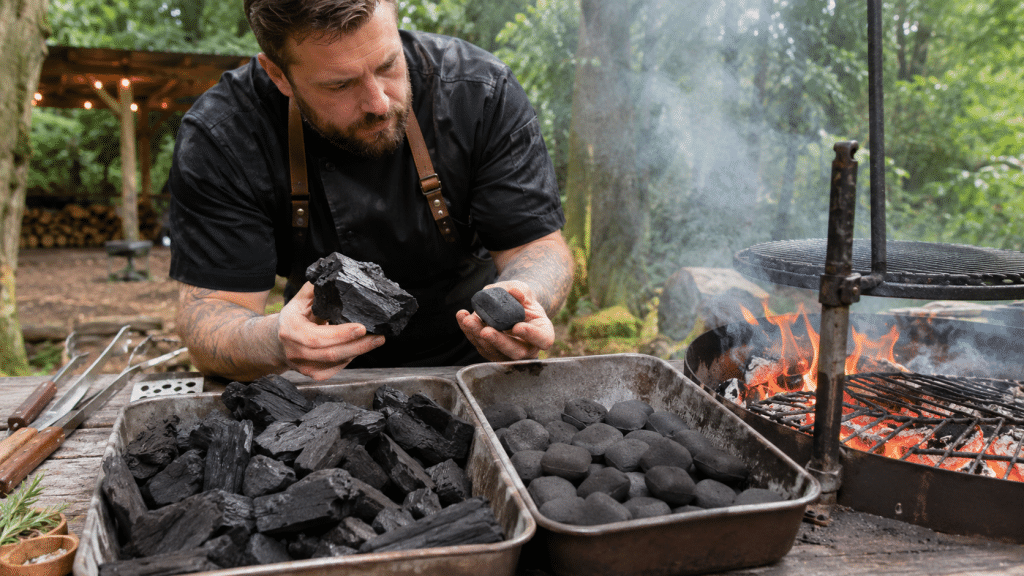
| What it is | Whole pieces of hardwood, carbonised. Nothing added | Charcoal dust and sawdust compressed with a binder |
| Typical additives | None in quality British lumpwood | Starch binder and limestone, sometimes other binders or accelerants |
| Peak temperature | Roughly 700C to 900C | Roughly 430C to 540C |
| Time to ready | 15 to 20 minutes | 20 to 30 minutes |
| Burn duration | 45 to 90 minutes of useful heat | 3 to 5 hours |
| Temperature stability | Responds fast to vents, needs attention | Very steady and forgiving |
| Ash produced | Low | High, often needs clearing mid-cook |
| Flavour | Clean, faintly sweet, wood character | Neutral at best, faintly chemical at worst |
| Best for | Searing, steaks, direct grilling, asado, anything under an hour | Brisket, pork shoulder, ribs, long lid-on cooks |
| Piece consistency | Variable, from fist-sized chunks to dust | Identical every time |
Our actual usage split across a class year is about 80 percent lumpwood and 20 percent briquettes. Lumpwood for everything we cook in front of people, because the heat is honest and it reacts when you need it to. Briquettes when something needs to sit at 120C for four hours while we are teaching something else.
If you only ever buy one type, buy lumpwood. If you have started getting into smoking, buy both and stop trying to make one bag do both jobs.
What do the words on the charcoal bag actually mean?
This is where most money gets wasted, because almost none of these terms are regulated.
“Restaurant grade” means nothing legally. In practice it usually means the producer has sieved out the small pieces and dust and bagged only the large lumps, which genuinely does burn longer and more predictably. From a good British producer it is worth the premium. On an anonymous imported bag it is a word someone printed.
“Hardwood” is meaningful and worth insisting on. Softwoods like pine and larch make brittle, spitty charcoal that burns out fast. The National Coppice Federation actively discourages willow, poplar, pine and larch as barbecue charcoal feedstock. If a bag will not name the species, assume the worst.
“Instant light” means ordinary charcoal soaked in a petroleum distillate. It works. It also puts solvent into your food if you start cooking before it has finished burning off, which most people do.
“Natural” and “premium” mean nothing at all.
What you actually want on the bag: a named hardwood species or group, a named country or county of origin, and ideally an FSC or Grown in Britain mark. Three facts. If a bag gives you all three, it is almost certainly decent charcoal.
Does it matter where your charcoal comes from?
More than almost anyone in the charcoal aisle will tell you, and for two separate reasons.
The UK burns well over 100,000 tonnes of barbecue charcoal a year. The National Coppice Federation puts British production at roughly 5,500 tonnes, which it states is under 6 percent of demand. In other words, upwards of 90 percent of the charcoal we burn is imported, mostly from South Africa, Namibia, Nigeria, Paraguay and Indonesia.
The ethical reason. Charcoal was exempted from the UK Timber Regulations, which means there is no legal requirement for a UK retailer to source it sustainably or prove where the wood came from. The National Coppice Federation has campaigned on exactly this point. Some imported charcoal comes from tropical hardwood and mangrove forest in regions with minimal enforcement, and British charcoal producers including the Dorset Charcoal Company have repeatedly flagged Paraguay, which they note has among the world’s highest rates of tropical deforestation, as a significant source of charcoal sold here. You can buy a bag in a British supermarket with no idea what was cleared to make it, and nothing on the packaging is obliged to tell you.
The practical reason, which is the one that will change your mind. Imported bulk charcoal is often poorly kilned and shipped damp. Under-kilned charcoal still contains volatile compounds that have not burned off, which is why some bags smoke acrid and grey for twenty minutes and taste of nothing good. Damp charcoal hisses, refuses to light, and gives you half the heat you paid for. The cheap bag is not cheap once you have used two thirds of it to cook one round of burgers.
Buying British is not a virtue purchase here. It is usually the better performing product, and because British producers sell direct, the price gap is far smaller than the supermarket shelf suggests.
What does charcoal actually cost per cook?
Price per kilo is a misleading number. What you care about is how many cooks a bag gives you, and that varies enormously depending on how much of the bag is usable lump rather than dust.
| Charcoal type | Typical UK price | Usable cooks from 10kg | Rough cost per cook |
|---|---|---|---|
| Supermarket own-brand lumpwood | £2.50 to £3.50 per kg | 4 to 5 | £5.00 to £8.75 |
| Supermarket briquettes | £1.50 to £2.50 per kg | 6 to 7 | £2.15 to £4.17 |
| Quality imported lumpwood | £2.50 to £3.50 per kg | 6 to 7 | £3.60 to £5.80 |
| British hardwood lumpwood | £3.00 to £4.50 per kg | 7 to 9 | £3.30 to £6.40 |
| Restaurant grade British lumpwood | £3.50 to £5.00 per kg | 8 to 10 | £3.50 to £6.25 |
A “cook” here means a standard 57cm kettle, direct grilling, feeding four to six people. Notice that fuel used per cook ranges from about 1kg with large dense restaurant grade lumps up to roughly 2.5kg with a dusty supermarket bag, and that is the entire point of the table. Prices are indicative UK retail as of autumn 2026 and vary by supplier and bag size.
The pattern is consistent. The cheapest lumpwood on the shelf is frequently the worst value, because a significant proportion of the bag is dust and fragments that fall straight through the charcoal grate before they ever burn. Note that supermarket own-brand and quality imported lumpwood often sit in the same price band and deliver very different results, which is why the label matters more than the price tag.
Buy in bulk. A 10kg or 12kg bag direct from a British producer usually lands 30 to 40 percent cheaper per kilo than a 2kg supermarket bag, and it will last a household most of a summer.
Which charcoal should you use for which cook?
| What you are cooking | Best fuel | Why |
|---|---|---|
| Steak, chops, burgers | Lumpwood, restaurant grade if you have it | You want maximum radiant heat for a fast, hard sear |
| Chicken pieces, sausages | Lumpwood, two-zone setup | Sear then finish off the direct heat |
| Whole chicken or joint, lid on | Briquettes, or lumpwood topped up | 60 to 90 minutes at a steady temperature |
| Brisket, pork shoulder, ribs | Briquettes with wood chunks for smoke | Four hours plus, and you want to stop fiddling |
| Pizza in a kettle or kamado | Lumpwood plus a couple of wood chunks | Lumpwood reaches and holds 400C plus far more readily, and produces less ash under a stone |
| Steak straight on the coals | Restaurant grade lumpwood, never briquettes | Briquette binders and ash are not going near food |
| Camping and portable | Small lumpwood or a compact briquette | Weight and pack size matter more than peak heat |
That last-but-one row matters. If you are cooking caveman steak directly on the embers, the food touches the fuel, so the fuel has to be clean carbonised wood and nothing else. This is the one situation where charcoal choice is not a preference, it is a requirement.
Does charcoal go off, and how should you store it?
Charcoal does not expire. It is essentially pure carbon and it will still burn in twenty years. What it does do is absorb water, aggressively, and damp charcoal behaves like a completely different and much worse product.
A bag left on a garage or shed floor through a British winter will pull moisture up through the concrete and out of the air. It will then hiss, steam, refuse to take, and eventually light at about half the heat you expected. People blame the brand. It is the floor.
Store it properly and it stays perfect indefinitely:
- Off the ground. A pallet, a shelf, a couple of bricks, anything.
- In a sealed container. A lidded metal bin or a heavy-duty plastic tub with a clip lid is ideal.
- Somewhere with air movement rather than a sealed damp cupboard.
- If a bag has got damp, spread it in the sun for a day, or add ten minutes to your lighting time and accept less heat.
The same rule applies to your firewood if you cook over logs, which we cover in our guide to the best wood for live fire cooking in the UK.
Should you use lighter fluid or instant light charcoal?
Short version: no. Use natural firelighters and a chimney starter, and put the lighter fluid in the bin.
Petroleum accelerants and instant light charcoal both work by adding a solvent to the fuel. The solvent does burn off, but the window in which people start cooking almost always overlaps with the window in which it is still burning off. That faint chemical edge people assume is just “what barbecue tastes like” is not barbecue. It is the fluid.
Natural wood wool and wax firelighters cost a few pounds for a box of fifty and leave no taste at all. A chimney starter costs about £20, lasts a decade, and removes almost every lighting problem there is. Our full walkthrough of the method is in how to light a charcoal BBQ, and the same principles scale up to open fires and garden fire pit cooking.
Can you mix charcoal and wood?
Yes, and for most people it is the single biggest flavour upgrade available.
Charcoal is your heat. Wood is your flavour. A bed of lumpwood with two or three fist-sized chunks of dry hardwood laid on top, once the coals have ashed over, gives you controllable heat plus genuine wood smoke. That is what most of what people call “proper barbecue flavour” actually is.
Use chunks rather than chips on a charcoal BBQ, because chips burn out in minutes. Use dry, seasoned hardwood, never anything painted, treated or resinous. And go easy. Two chunks is seasoning. Six chunks is a bonfire with meat on it.
If you want to build the whole fire from wood rather than charcoal, that is a different skill with different rules, and our guide to building a cooking fire covers it properly.
Where can you learn fuel management properly?
You can read about charcoal all afternoon. Standing over a fire with someone who cooks on one for a living is a different kind of learning, and it sticks.
Our live fire and BBQ class experiences in Kent run 10am to 4pm in private woodland. You will light fires, handle different fuels side by side and actually taste the difference between a good bag and a bad one, manage heat across multiple cooking setups, and eat a full themed feast that you cooked yourself. Ingredients, equipment, refreshments, a take-home fire cooking manual and your own apron are all included. Complete beginners are welcome, and most people arrive having only ever used a supermarket disposable.
Buying for someone else? A BBQ experience gift voucher is the answer for the person who already owns four sets of tongs and three bags of charcoal.
Book your slot or get in touch to build a custom day for a group.
Frequently asked questions
What is the best charcoal for a BBQ in the UK? British hardwood lumpwood charcoal is the best all-round choice. It lights in 15 to 20 minutes, burns considerably hotter than briquettes, contains no binders or additives, and gives a clean flavour. Use quality briquettes instead for cooks lasting more than two hours.
Is lumpwood or briquette charcoal better? Neither is better overall, they suit different cooks. Lumpwood burns hotter and faster and is better for searing and direct grilling. Briquettes burn cooler, longer and more steadily, and are better for low and slow cooking with the lid on.
What charcoal do restaurants use? Most UK restaurants use large-piece lumpwood charcoal, often sold as restaurant grade, because it burns hot and long with predictable heat output and low ash. Note that “restaurant grade” is a marketing description, not a regulated standard, so it is only meaningful from a producer who names the species and the origin.
Is instant light charcoal bad? It works, but the charcoal is impregnated with a petroleum-based accelerant that can leave a solvent taste if you start cooking before it has fully burned off. It is fine for a one-off picnic with no kit, and not worth it at home.
Does charcoal go off or expire? No. Charcoal is essentially pure carbon and does not degrade. It does absorb moisture from the air, though, and damp charcoal is hard to light and burns cooler. Store it off the ground in a sealed container and it stays usable indefinitely.
Is British charcoal better than imported? Usually, yes, for practical as well as ethical reasons. British hardwood charcoal is typically better kilned and drier, so it lights faster and burns hotter. Upwards of 90 percent of UK charcoal is imported, and because charcoal is exempt from the UK Timber Regulations there is no legal requirement for importers to prove sustainable sourcing.
How much charcoal do I need for a BBQ? For a standard 57cm kettle doing direct grilling for four to six people, 1.5 to 2kg of good lumpwood is about right. A dusty bag will need more and large restaurant grade lumps will need less. Allow 2.5 to 3kg for a longer lid-on cook.
Can you mix charcoal and wood on a BBQ? Yes, and you should. Use charcoal as the heat source and add two or three chunks of dry seasoned hardwood once the coals have ashed over, for genuine wood smoke flavour with controllable heat.
Why is my charcoal so ashy and smoky? Usually under-kilned or damp charcoal. Cheap imported bags often contain residual volatile compounds that produce acrid grey smoke, and bags stored on a damp floor steam rather than burn. Both problems disappear with a well-kilned, dry, hardwood bag.
