

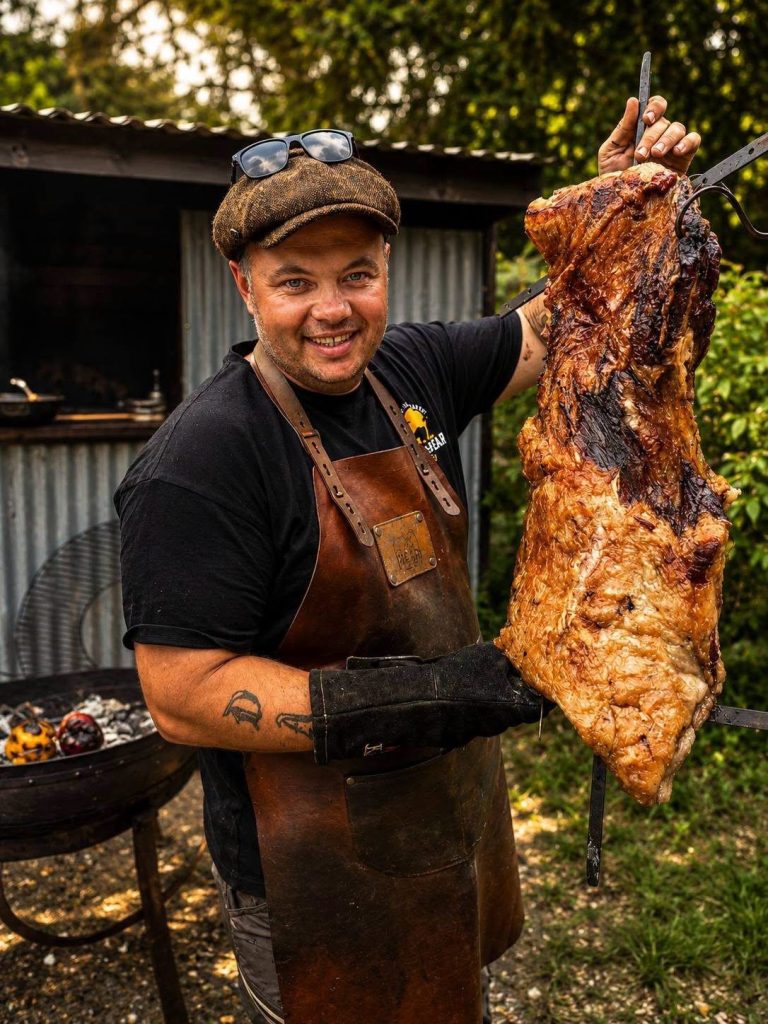
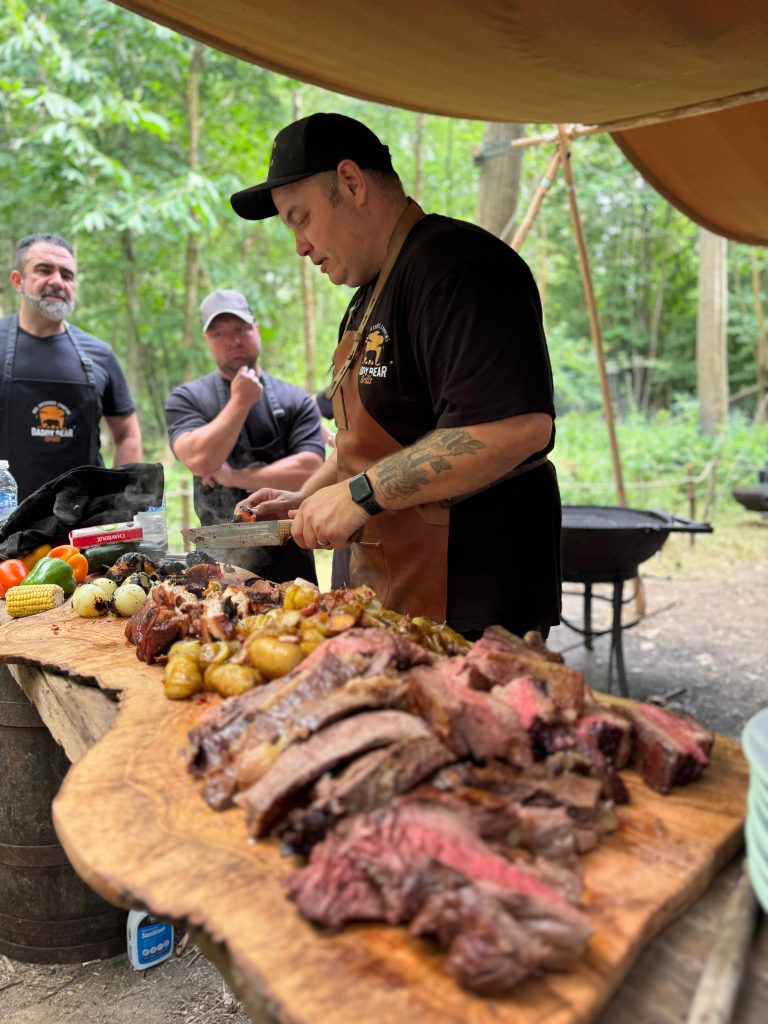
By Wayne Smith, live fire chef and founder of Daddy Bear Grills, British Live Fire Championship finalist. Written from our private woodland at Liz’s Yard in Kent.
TL;DR
Fire pit cooking means using a garden fire pit as a genuine cooking appliance rather than just a heat source. The method is simple: burn kiln dried hardwood down to a bed of glowing embers, build two or three heat zones inside the pit, then cook over the embers rather than over flames. In England you must buy wood in units under 2m³ that carries a Ready to Burn certification, which guarantees a moisture content of 20% or less. Fire pits are legal in most of the UK, but smoke control areas and statutory nuisance rules under the Environmental Protection Act 1990 still apply. Autumn is the best fire pit season in Britain, not summer, because cooler air makes standing by a fire pleasant and hardwood burns cleaner in dry weather. We teach the whole method on our live fire and BBQ class experiences in Kent.

What is fire pit cooking?
Fire pit cooking is the practice of cooking food over, in, or beside the embers of an open fire held in a contained pit or bowl. It sits between campfire cooking and barbecue. You get the smoke, radiant heat and control of a live fire, in a vessel that lives in your garden all year.
The critical distinction, and the one almost nobody makes clearly, is this: you do not cook over flames, you cook over embers. Flames are unpredictable, they deposit soot, and they scorch the outside of food long before the middle is warm. Embers give steady, dry, radiant heat that you can actually read and control. Every technique below depends on getting to that ember bed first.
If fire building itself is new to you, start with our step by step guide to building a cooking fire, then come back here for what to do with it.
Can you cook on any fire pit?
Almost, but some designs make life much easier. The main constraint is whether you can get a stable cooking surface at a sensible height above a deep ember bed.
| Fire pit type | Good for cooking? | What to know |
|---|---|---|
| Steel bowl or dish (Kadai style) | Excellent | Deep enough for a proper ember bed. Usually sold with a swing arm grill or tripod. The classic UK choice. |
| Corten or steel plate pit with a hob edge | Excellent | The flat top ring doubles as a griddle for onions, flatbreads and eggs. Very forgiving. |
| Brick or stone built pit | Excellent | Retains heat superbly and holds a big ember bed. Fixed, so plan the position carefully. |
| Tripod and cauldron | Good | Brilliant for stews, curries and stock. Limited for searing. |
| Shallow chiminea | Limited | Chimney design pulls heat upward and away. Fine for warmth, frustrating for food. |
| Cheap thin steel bowl | Limited | Warps and burns through within a season or two of real cooking heat. Buy 3mm steel or thicker. |
| Gas fire pit | No | No embers, no smoke, no flavour. It is a patio heater with ambience. |
The upgrade that transforms almost any pit is an adjustable height grill. Being able to raise the grate 5cm is the fire pit equivalent of turning a hob down.
What wood should you burn on a fire pit in the UK?
Kiln dried hardwood, and in England it must legally be certified. Since May 2021, the Air Quality (Domestic Solid Fuels Standards) (England) Regulations 2020 have required wood sold in volumes under 2m³ for domestic burning to carry a Ready to Burn certification, administered by Woodsure on behalf of Defra. That certification confirms a moisture content of 20% or less. Look for the logo, the supplier name and a certification number on the bag.
This is not bureaucratic box ticking. Wet wood is the single biggest cause of bad fire pit food. Above 20% moisture, the fire spends its energy boiling water instead of making heat, produces thick acrid smoke, and coats your dinner in creosote flavours.
What to burn, and what to avoid:
- Best: oak, ash, beech, hornbeam, and fruit woods such as apple and cherry for a sweeter smoke. Our guide to the best wood for live fire cooking in the UK goes into species by species detail.
- Avoid: pine, spruce and other softwoods. Resinous, spitty, and they taste of turpentine.
- Never: treated, painted, glued or reclaimed timber, pallets, MDF, or anything you found in a skip. These release genuinely toxic fumes.
- Never: garden waste or damp leaves. They smoulder rather than burn, which is exactly what upsets neighbours and councils.
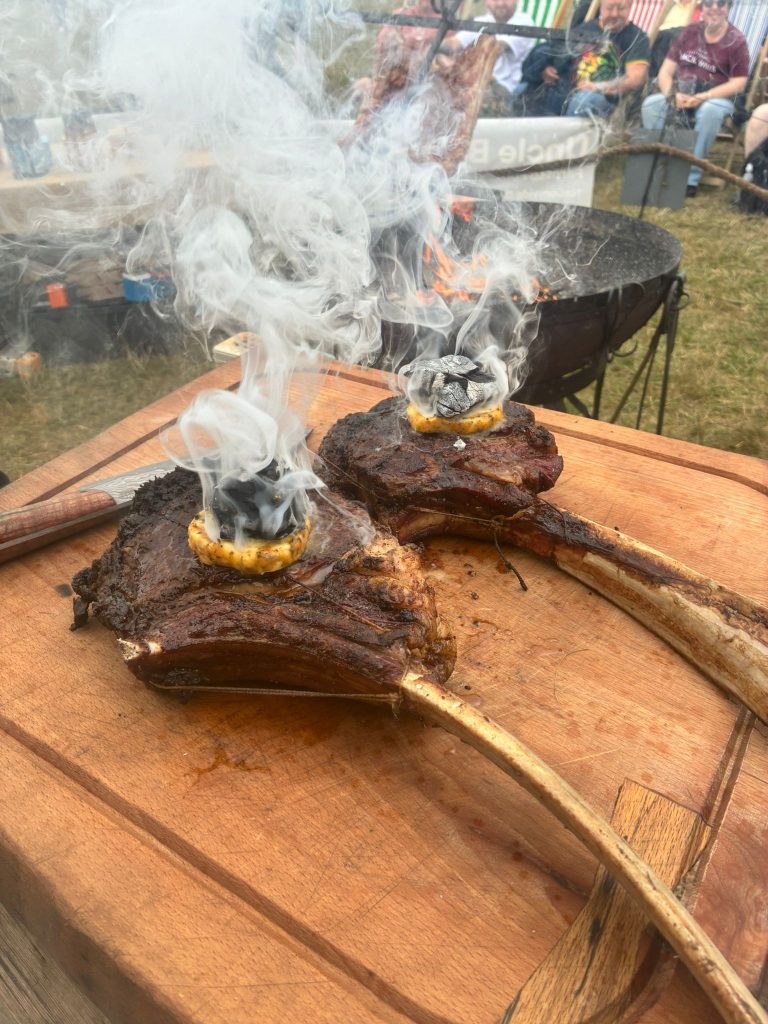
Charcoal briquettes deserve a mention too. They contain binders and fillers that transfer to food, which is why we use lump charcoal or wood embers only. That matters especially for direct coal techniques like caveman steak.
Are fire pits legal in the UK?
Yes, in most circumstances, and this question comes up on nearly every class day. Fire pits are not banned. But two rules are worth knowing.
Smoke control areas. Large parts of urban Britain are designated smoke control areas, including most of London and parts of Manchester, Birmingham and Glasgow. Within them, burning wood is restricted unless you use an exempt appliance or an authorised fuel. Your local council website will tell you your status in about thirty seconds.
Statutory nuisance. Even outside a smoke control area, persistent smoke that affects a neighbour’s use or enjoyment of their property can be a statutory nuisance under section 79 of the Environmental Protection Act 1990. Councils can serve an abatement notice, and ignoring one is a criminal offence carrying fines of up to £5,000 for households.
In practice, a contained fire pit burning Ready to Burn hardwood for an evening, supervised, in daylight or early evening, almost never causes a problem. Smouldering garden waste at eleven at night does. The rule of thumb is simple: if you can see a thick column of smoke, you have built the fire wrong.
How do you set up a fire pit for cooking? Step by step
- Light it early. Allow 30 to 45 minutes from lighting to a usable ember bed with wood, or 20 to 25 minutes with lump charcoal. This is the step everyone underestimates. Light the fire before your guests arrive, not when they do.
- Burn down, do not cook up. Wait until the flames have died back and the wood has collapsed into glowing orange embers with a light grey ash coat. That is your cooking heat.
- Build heat zones. Rake roughly two thirds of the embers to one side for a hot searing zone, leave a thinner layer in the middle for medium heat, and keep a third of the pit almost clear as a safe holding zone. This one move gives you the control that a fire pit is usually accused of lacking.
- Keep a feeder fire going. Add a small log to the hot zone every 15 to 20 minutes so you are constantly generating fresh embers. Never add fresh wood directly under food that is cooking.
- Set your grill height. Roughly 10cm above the embers for searing, 20cm to 25cm for anything that needs to cook through. Hold your hand at grate height. If you can keep it there for two seconds, that is searing heat. Five to six seconds is medium.
- Cook by zone, not by timer. Sear over the hot side, then move food to the medium or holding zone to finish. Use a digital probe rather than guesswork.
- Let it die down safely. Never douse a hot pit with water, which can warp steel and throw scalding steam. Let it burn out, and clear cold ash before the next cook so air can reach the fire from below.
What can you cook on a fire pit?
Far more than burgers. Here is how the main methods map to food.
| Method | How it works | Best foods |
|---|---|---|
| Grilling over embers | Grate 10cm to 20cm above the coals | Steaks, chops, chicken thighs, sausages, halloumi, spatchcock chicken |
| Direct on the coals | Food laid straight onto the ember bed | Thick steaks, whole onions, aubergines, peppers, sweet potatoes, leeks |
| Skillet and plancha | Cast iron pan set on the grate or the pit edge | Eggs, mushrooms, flatbreads, prawns, smash burgers, hash |
| Dutch oven | Lidded pot buried in or hung over embers | Stews, chilli, curries, bread, cobblers, mulled cider |
| Hanging and tripod | Meat suspended above and rotated | Whole chickens, pork shoulder, lamb legs, gammon |
| Ash roasting | Food buried in the hot ash at the edge | Whole squash, beetroot, garlic bulbs, jacket potatoes |
| Skewers and asado cross | Food angled beside the fire, cooked by radiant heat | Lamb, pork belly, whole fish, kebabs. Our Argentinian asado guide covers this properly |
If you only learn one thing, learn ash roasting. A whole onion buried in the embers for 40 minutes, split open with a knob of butter and salt, converts more sceptics than any steak we have ever cooked.
What kit do you actually need?
Ignore the accessory catalogues. The genuinely essential list is short.
- Long tongs. 40cm minimum. The single most useful tool you will own.
- Heat resistant gloves. Welding gauntlets are cheaper and better than most branded barbecue gloves.
- A digital probe thermometer. Non negotiable. Fire varies, thermometers do not.
- An adjustable height grate. The closest thing a fire pit has to a temperature dial.
- A cast iron skillet. Doubles your menu instantly.
- A fire poker or rake. For moving embers and building zones.
- A bucket of sand or a fire blanket. Not water. Sand.
Everything beyond that is nice to have. A rotisserie, a plancha ring, an asado cross and a hanging tripod are all excellent, and all optional.
Why autumn is the best fire pit season in Britain
Most people put the fire pit away in September, which is exactly backwards.
Cooler air makes standing next to a 400C ember bed genuinely pleasant rather than punishing. Autumn produce, squash, apples, mushrooms, game, brassicas, suits slow ember cooking better than anything the summer offers. Kiln dried wood stored properly burns cleaner in cold dry air than in muggy August. And crucially, an autumn evening around a fire pit lasts longer, because darkness arrives at a civilised hour instead of half past nine.
The one thing to plan for is heat loss from wind. Position the pit with a wall, hedge or fence to windward, keep the ember bed deeper than you would in summer, roughly 10cm rather than 7cm, and expect to feed it a little more often.
Common fire pit cooking mistakes
- Cooking over flames. Wait for embers. Every single time.
- Wet or uncertified wood. Buy Ready to Burn. Sooty food starts here.
- A shallow ember bed. Under 7cm and the heat dies the moment food goes on.
- One heat zone. Without a cool side you have no escape route for anything that is browning too fast.
- Adding wood under the food. Fresh logs mean flames, soot and flare ups. Feed the fire off to one side.
- Guessing doneness. Use a probe. UK Food Standards Agency guidance allows whole cuts of beef and lamb to be served pink provided the outside surface is properly sealed, but burgers, sausages and any minced or rolled meat must be cooked through.
- Dousing the pit with water. Warps the steel and creates a steam hazard. Let it burn out.
Frequently asked questions
Can you cook on a fire pit? Yes. Any fire pit with enough depth to hold a bed of embers can be cooked on, and most sold in the UK come with or accept a grill grate. The key is cooking over glowing embers rather than open flames.
What wood is best for fire pit cooking? Kiln dried hardwoods such as oak, ash, beech and fruit woods. In England, wood sold in volumes under 2m³ must carry Ready to Burn certification confirming 20% or less moisture content. Avoid softwoods, treated timber and garden waste.
How long does a fire pit take to be ready for cooking? Around 30 to 45 minutes with wood, or 20 to 25 minutes with lump charcoal, from lighting to a usable ember bed. Light it well before you plan to eat.
Are fire pits illegal in the UK? No. Fire pits are legal in most of the UK. Restrictions apply in smoke control areas, and persistent smoke can be treated as a statutory nuisance under the Environmental Protection Act 1990. Check your local council for your area’s status.
Can you use charcoal in a fire pit? Yes. Lump charcoal is an excellent fast route to an ember bed. Avoid briquettes, which contain binders that taint food, and never use self lighting charcoal.
What is the difference between a fire pit and a BBQ? A barbecue is a purpose built cooking appliance with a fixed grate and usually a lid. A fire pit is an open fire vessel, so you control heat by moving embers and adjusting grate height rather than by closing vents.
Is fire pit cooking safe in the rain? A light drizzle is fine with a deep ember bed. Heavy rain will kill the fire and can crack stone pits through thermal shock. A simple gazebo or open sided shelter, well clear of the flames, solves it.
Learn it properly in the Kent woodland
You can read about ember beds all day. Reading the heat with your own hand and cooking a full menu on it is a different thing entirely.
Fire pit management, zone building, ember reading, hanging, ash roasting and asado are all part of our full day live fire and BBQ class experiences at our private woodland outside Maidstone. You build the fire, you run it, you cook, and you eat everything you make. Days run from roughly 10am to 4pm, all ingredients and equipment are included, and you leave with a fire cooking manual and a Daddy Bear Grills apron.
Book the Live Fire Cooking Woodland Experience, or if you are still weighing up your options, our guide to BBQ cooking classes and how to pick the right one will help. For group bookings, corporate days and private dates, get in touch.