

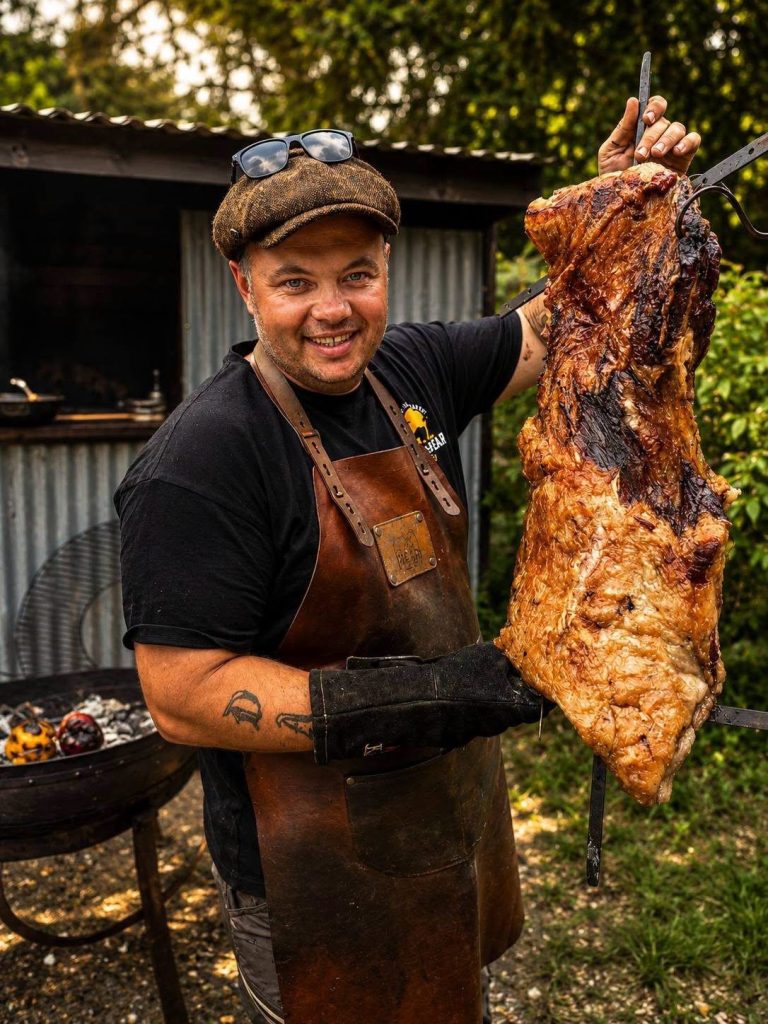
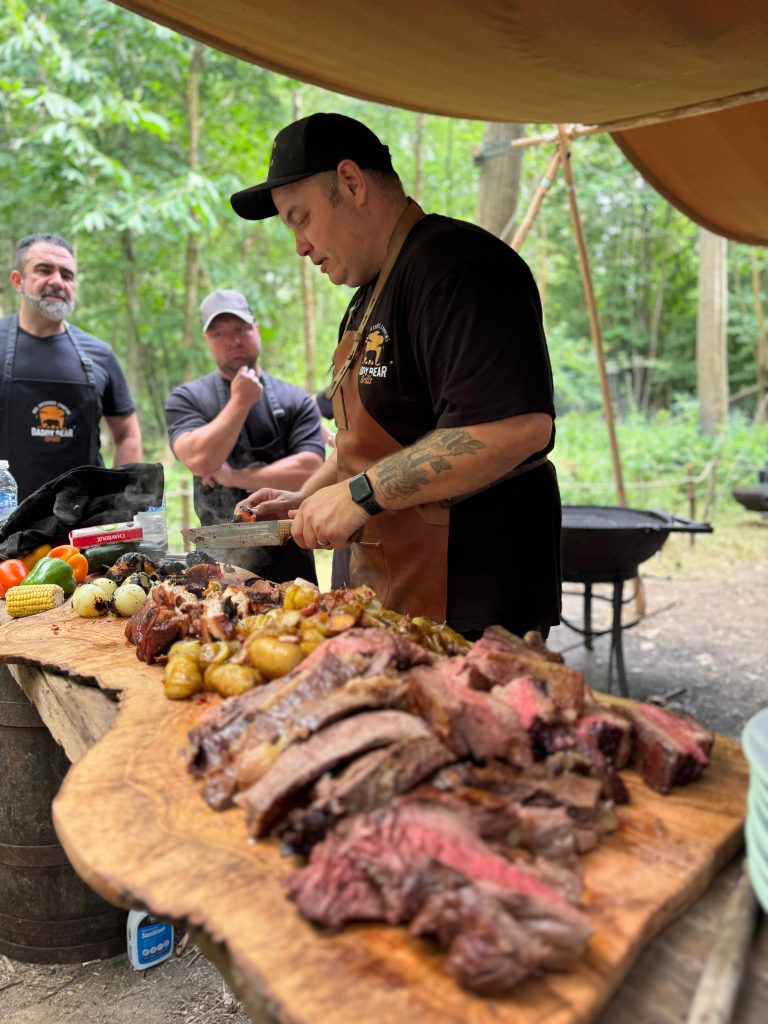
By Wayne Smith, live fire chef and founder of Daddy Bear Grills, British Live Fire Championship finalist. Written from our private woodland at Liz’s Yard in Kent.
TL;DR
A caveman steak, also called a dirty steak, is a thick cut steak laid straight onto glowing hot coals with no grill grate in between. The coals sear the surface almost instantly, which gives you a deep crust and a smoky, mineral edge you cannot get on a gas grill. Use a steak at least 4cm thick, burn down lump charcoal or hardwood to a bed of grey glowing embers, fan off the loose ash, cook roughly 3 to 5 minutes per side, pull at 52C to 54C internal for medium rare, then rest for 5 to 10 minutes. It comes out cleaner than people expect, because ash brushes straight off. We teach this technique on every live fire and BBQ class in our Kent woodland.

What is a caveman steak?
A caveman steak is a steak cooked directly on burning embers rather than on a grill above them. There is no grate, no gap, no gas. The meat sits in contact with the coals themselves.
You will also hear it called a dirty steak, a cowboy steak, a coal roasted steak, or an Eisenhower steak. That last name comes from US President Dwight D. Eisenhower, who was known for throwing steaks straight onto the coals at White House cookouts and who is largely responsible for the technique becoming famous in the first place.
The appeal is simple. Radiant heat from a proper ember bed is fierce, and putting meat in direct contact with it produces an extremely fast, extremely aggressive sear. You get the Maillard crust that people chase with cast iron pans, but with woodsmoke layered on top of it.
Does the steak actually get covered in ash?
No, and this is the single most common objection we hear on class days. Once the coals are properly burned down and you fan the loose surface ash away, very little transfers. What does stick brushes off with a pastry brush or a quick wipe once the steak comes off the fire.
The trick is timing. If you drop meat onto coals that are still flaming and smoking, you get soot, which is greasy and does taste bad. If you wait until the fire has settled into an even bed of grey, glowing embers, you get clean, dry heat. Soot is the enemy, not ash.
Use lump charcoal or burned down hardwood, never briquettes. Briquettes are held together with binders and fillers, and those additives sit on the surface of the coal and transfer straight onto your food. Our guide to the best wood for live fire cooking in the UK covers which species burn down into the kind of dense, long lasting embers this technique needs.
What cut of steak works best for caveman cooking?
Thickness matters more than the cut. Anything under about 4cm will overcook before the crust forms, and you will end up with a grey, sad steak wearing a great crust. Aim for 4cm to 5cm minimum, ideally a single large steak carved and shared rather than one each.
| Cut | Thickness to look for | Why it works on coals |
|---|---|---|
| Ribeye | 4cm to 5cm | High intramuscular fat bastes the meat as it sears. The most forgiving choice for a first attempt. |
| Sirloin with fat cap | 4cm to 5cm | Firmer bite, excellent crust. Trim the fat cap slightly to reduce flare ups. |
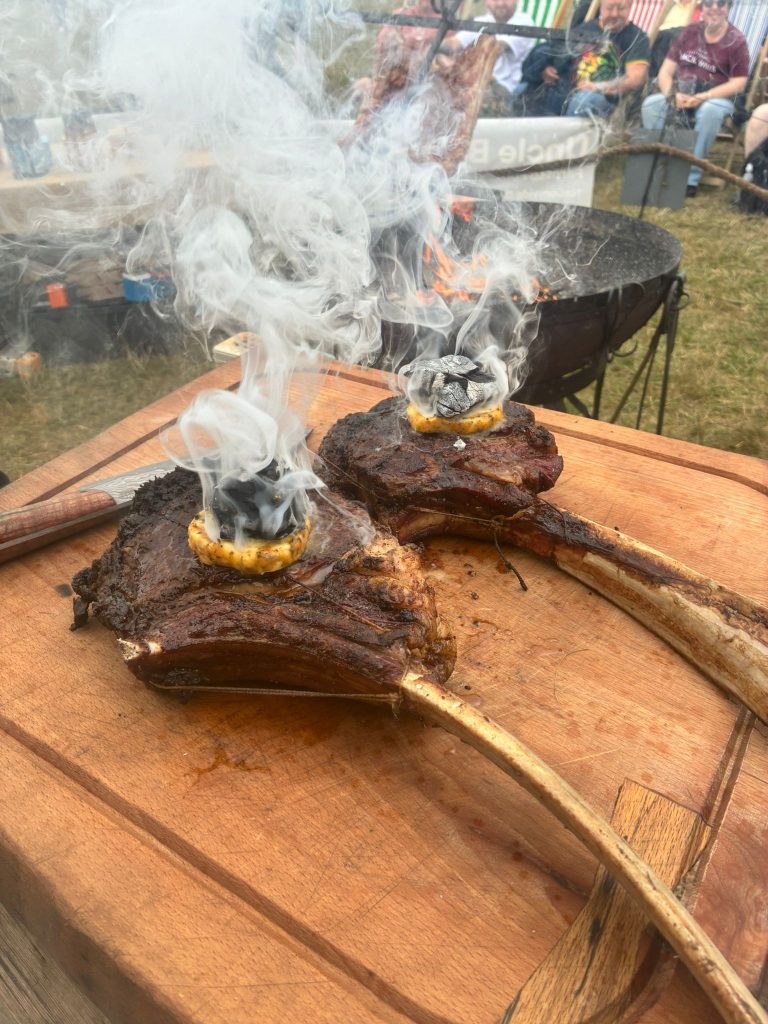
| Tomahawk or bone in ribeye | 5cm plus | Best for a crowd and a bit of theatre. The bone handle makes flipping easier. |
| Rump | 4cm plus | Cheapest route in. Needs accurate temping and a proper rest, and must be carved across the grain. |
| Picanha | Whole cap, 4cm portions | Fat cap crisps beautifully. Our Argentinian asado guide covers the South American approach in more depth. |
Take the steak out of the fridge 45 to 60 minutes before cooking so the centre is not fridge cold, and pat the surface completely dry. Moisture is what stops a crust forming. Season generously with coarse salt just before it goes on, and hold the pepper back until after cooking, because pepper scorches on direct coals and turns bitter.
How do you cook a caveman steak? Step by step
- Build and burn down the fire. Light lump charcoal or split hardwood and let it burn until the flames have died and you have a bed of glowing embers coated in light grey ash. That usually takes 30 to 45 minutes with wood, or 20 to 25 minutes with lump charcoal. If you want the fire lay itself explained properly, read our step by step guide to building a cooking fire.
- Rake the bed flat and deep. Spread the coals into an even layer at least 7cm to 8cm deep, and slightly wider than the steak. A thin bed cools the moment the meat lands on it.
- Blow off the ash. Fan the surface with a piece of card, a bellows or a hairdryer on cold until the coals glow orange and the loose ash lifts away. This step is what keeps the steak clean.
- Lay the steak straight on. Place it down confidently and leave it alone. Do not poke it. Expect a little smoke and a smell that will bring the neighbours out.
- Cook 3 to 5 minutes per side. For a 4cm steak on a properly hot bed, 3 to 4 minutes a side gets you to medium rare. Flip once with long tongs.
- Temp it, do not guess. A digital probe is the difference between a triumph and an expensive lesson. Pull at the temperatures in the table below.
- Brush, rest, then finish. Brush off any clinging ash, rest the steak on a warm plate or board for 5 to 10 minutes, then add cracked pepper, flaky salt and a knob of butter or a spoonful of chimichurri. Carve across the grain.
What internal temperature should a caveman steak be?
Pull the steak off the coals about 2C to 3C below your target, because carryover cooking continues while it rests.
| Doneness | Pull temperature | Final temperature after rest |
|---|---|---|
| Rare | 48C to 50C | 50C to 52C |
| Medium rare | 52C to 54C | 54C to 57C |
| Medium | 57C to 60C | 60C to 63C |
| Medium well | 63C to 65C | 65C to 68C |
| Well done | 68C plus | 71C plus |
A note on food safety. UK Food Standards Agency guidance is that whole cuts of beef and lamb, such as steaks and joints, can be served rare or pink in the middle provided the entire outside surface has been properly sealed by cooking. Caveman searing does exactly that, and does it more thoroughly than most methods. The same does not apply to burgers, sausages, rolled joints or any minced or pierced meat, which must be cooked all the way through.
Caveman steak vs grilling on a grate: which is better?
Both have their place. Direct coal contact is faster and more dramatic, a grate gives you more control. Here is the honest comparison.
| Caveman, directly on coals | Grilled on a grate above coals | |
|---|---|---|
| Sear speed | Extremely fast, crust in 3 to 4 minutes | Slower, 4 to 6 minutes a side |
| Flavour | Deep, smoky, slightly mineral | Cleaner, more familiar barbecue flavour |
| Control | Low. Committed once the steak is down | High. You can move the steak around the heat |
| Best for | Thick steaks, 4cm plus | Any thickness, plus fish and vegetables |
| Flare up risk | Low, no dripping fat to ignite below | Higher, fat drips onto coals |
| Kit needed | Long tongs, heat gloves, probe | Grill, tongs, probe |
| Difficulty | Moderate. Mostly about fire timing | Easy |
The real answer used by most fire cooks is to combine them. Reverse sear the steak gently on a grate or in an indirect zone until it reaches around 45C, then finish it caveman style on the coals for 60 to 90 seconds a side. You get an evenly cooked interior and a savage crust, with much less risk of overshooting.
What can go wrong, and how to avoid it
- Sooty, acrid flavour. You went on too early while the fire was still flaming. Wait for grey and glowing.
- Burnt outside, raw inside. Your steak was too thick for the time, or the bed was too hot and too close. Reverse sear instead.
- Grey and overcooked. Your steak was too thin. Under 4cm, use a grate.
- Steak welded to the coals. The bed was not hot enough at the surface. Fan harder before the meat goes on.
- Bitter crust. You peppered before cooking. Pepper afterwards.
- Burnt knuckles. Use long tongs and proper heat resistant gloves. Fire has no sense of humour.
Frequently asked questions
Is caveman steak safe to eat? Yes, when cooked properly. Direct coal contact seals the entire outside surface of the meat, which is what FSA guidance requires for whole cuts of beef and lamb served pink. Use clean lump charcoal or untreated hardwood, never briquettes, treated timber, or wood that has been painted or glued.
Can I do caveman steak on a normal kettle barbecue? Yes. Fill the charcoal basket with lump charcoal, let it burn down to embers, remove the cooking grate, rake the coals flat and lay the steak straight on. A kettle actually helps, because the walls hold the heat in.
What is the difference between a caveman steak and a dirty steak? Nothing. They are two names for the same technique. Cowboy steak, coal roasted steak and Eisenhower steak all describe it too.
Do I need special charcoal? You need lump charcoal or burned down hardwood. Avoid briquettes and never use self lighting charcoal, because the lighter fluid taste transfers directly to the meat.
How thick should the steak be? At least 4cm, ideally 5cm. Thinner steaks overcook before the crust develops.
Can you cook anything else directly on coals? Plenty. Whole onions, aubergines, peppers, sweet potatoes, leeks and cabbage all take beautifully to being buried in embers, and lamb chops work well too. We cook several of these on class days alongside the steaks.
Try it with us in the Kent woodland
Reading about fire and standing in front of one are two different things. Caveman steak is one of the techniques we teach on our full day live fire and BBQ class experiences at our private woodland outside Maidstone, alongside fire management, hanging, asado and campfire cooking. You build the fire, you read the embers, you cook, and you eat everything you make.
Days run from roughly 10am to 4pm, all ingredients and equipment are included, and you go home with a fire cooking manual and a Daddy Bear Grills apron. Book the Live Fire Cooking Woodland Experience, or if you are weighing up your options first, our guide to BBQ cooking classes and how to pick the right one will help you choose. For group bookings and private dates, get in touch.